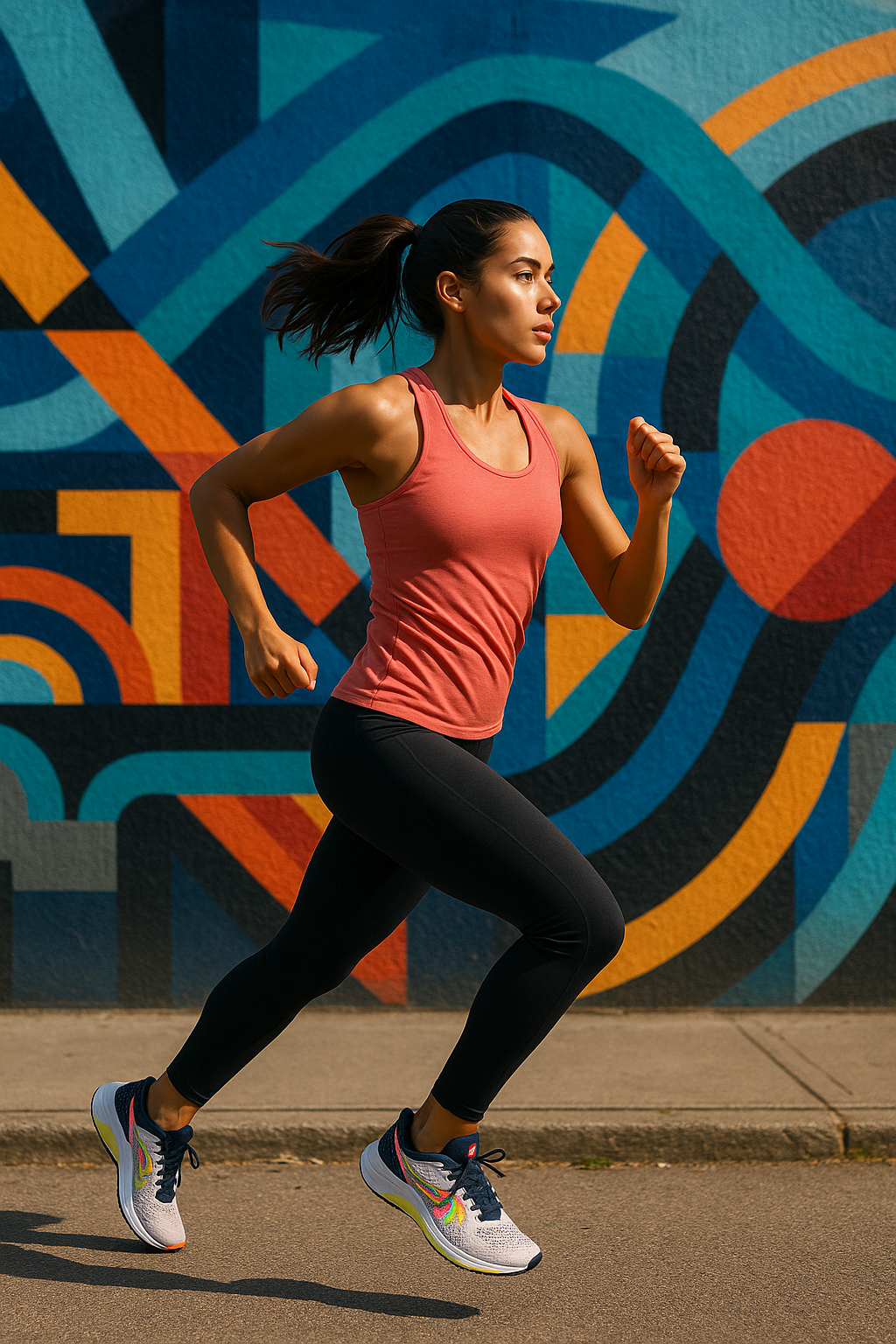
Proper Running Technique: A Biomechanical and Physiological Approach to Injury Prevention and Efficiency
Running technique plays a critical role in both injury prevention and the optimization of running economy. An appropriate posture—with the body slightly leaning forward from the ankles and the head held upright while the gaze is fixed approximately 10–20 meters ahead—supports a natural alignment of the center of mass and reduces unnecessary muscular tension. The shoulders should remain relaxed, and the arms should swing rhythmically at roughly a 90-degree angle at the elbows, close to the torso, thereby promoting stability and forward propulsion.
Foot contact should occur at the midfoot directly beneath the body’s center of mass. This reduces vertical loading forces on the knees and hips and consequently lowers the risk of overuse injuries. A heel strike positioned far in front of the body increases braking forces with each step and has been associated with a higher incidence of lower limb injuries (Lieberman et al., 2010). Therefore, runners are encouraged to adopt a short, quick stride with a cadence of approximately 170–180 steps per minute, which has been linked in the literature to reduced joint loading and improved efficiency (Heiderscheit et al., 2011).
Core musculature is essential for maintaining pelvic stability during running. A well-activated core system prevents lateral movements and minimizes energy leakage. Breathing, often overlooked, is also vital; rhythmic and controlled respiration—ideally through both the nose and mouth—enhances oxygen delivery and helps prevent excessive muscular tension.
Preventive training that includes dynamic warm-up routines, mobility exercises, and targeted strength work—particularly focusing on the hip flexors, hamstrings, and calves—is crucial for sustaining optimal technique over extended distances and higher loads. Running-specific drills such as skips, butt kicks, and high knees can be integrated into warm-up sessions to reinforce neuromuscular control (Barton et al., 2012).
Finally, footwear should be selected based on individual biomechanical needs. Research shows that neither minimalist nor maximally cushioned shoes are universally optimal; thus, a running gait analysis and personal comfort should guide shoe choice. Regular technique monitoring—for example, via video feedback—is recommended, as even minor adjustments can significantly affect performance and injury risk (Nigg et al., 2015).
In summary, effective and injury-resistant running technique results from biomechanically sound movement patterns, functional muscular support, and thoughtful training strategies. A holistic approach that integrates technique, strength, equipment, and recovery offers the best foundation for the sustainable runner.
References:
- Barton, C. J., Levinger, P., & Crossley, K. M. (2012). The relationship between dynamic lower limb biomechanics and patellofemoral pain: a systematic review. Sports Medicine, 42(10), 865–878.
- Heiderscheit, B. C., Chumanov, E. S., Michalski, M. P., Wille, C. M., & Ryan, M. B. (2011). Effects of step rate manipulation on joint mechanics during running. Medicine & Science in Sports & Exercise, 43(2), 296–302.
- Lieberman, D. E., Venkadesan, M., Werbel, W. A., et al. (2010). Foot strike patterns and collision forces in habitually barefoot versus shod runners. Nature, 463(7280), 531–535.
- Nigg, B. M., Baltich, J., Hoerzer, S., & Enders, H. (2015). Running shoes and running injuries: mythbusting and a proposal for two new paradigms: ‘preferred movement path’ and ‘comfort filter’. British Journal of Sports Medicine, 49(20), 1290–1294.
https://shorturl.fm/QtfoL
https://shorturl.fm/gRJUp
https://shorturl.fm/zgyvI
https://shorturl.fm/mOh09
https://shorturl.fm/Org65
https://shorturl.fm/cVwXo
https://shorturl.fm/eAvVj
https://shorturl.fm/sBmOc
https://shorturl.fm/W2c8b
https://shorturl.fm/rz8BC
https://shorturl.fm/8pWkV
https://shorturl.fm/aicHu
https://shorturl.fm/FHYWa
https://shorturl.fm/B9zMt
https://shorturl.fm/zLsw3
https://shorturl.fm/7ks4c
https://shorturl.fm/43S60
https://shorturl.fm/RbCjb
https://shorturl.fm/uVdJj
https://shorturl.fm/ZgSFP
https://shorturl.fm/TmdEf
https://shorturl.fm/iifX7
https://shorturl.fm/WzyiJ
https://shorturl.fm/9FzZl
https://shorturl.fm/7NDXl
https://shorturl.fm/hlhtb
https://shorturl.fm/qz3yn
https://shorturl.fm/LCuds
https://shorturl.fm/OstRh
https://shorturl.fm/ax8pK
https://shorturl.fm/Bzg7Q
https://shorturl.fm/4uxcs
https://shorturl.fm/Y8oTh
https://shorturl.fm/E6PXt
https://shorturl.fm/qK5I2
https://shorturl.fm/O33nH
https://shorturl.fm/8Gio9
https://shorturl.fm/0aPOL
https://shorturl.fm/BdQxv
https://shorturl.fm/Cmh6j
https://shorturl.fm/9dR3s
https://shorturl.fm/3iboY
https://shorturl.fm/0bZif
https://shorturl.fm/8o4Ng
https://shorturl.fm/NocQ2
https://shorturl.fm/CGEum
https://shorturl.fm/7KiZL
https://shorturl.fm/aN5pj
https://shorturl.fm/oaLMh
https://shorturl.fm/Ajlxb
https://shorturl.fm/FP1WS
https://shorturl.fm/Y3hdK
https://shorturl.fm/lifOd
https://shorturl.fm/L11EJ
https://shorturl.fm/w8pEX
https://shorturl.fm/fKENA
https://shorturl.fm/rStR6
https://shorturl.fm/7i1U9
https://shorturl.fm/4YOsv
https://shorturl.fm/KD5PI
https://shorturl.fm/lP7Vk
https://shorturl.fm/cAN2H
https://shorturl.fm/rRPaN
https://shorturl.fm/KwiP5
https://shorturl.fm/kJ53h
https://shorturl.fm/0gzy4
https://shorturl.fm/7b95i
https://shorturl.fm/KB2si
https://shorturl.fm/NdTC7
https://shorturl.fm/r2Dw0
https://shorturl.fm/eYEqV
https://shorturl.fm/NPcly
https://shorturl.fm/hqYHi
https://shorturl.fm/rNtNu
https://shorturl.fm/Ww8oW
https://shorturl.fm/uXfvP
https://shorturl.fm/ObqgL
https://shorturl.fm/sRGlI
https://shorturl.fm/rxhg6
https://shorturl.fm/Z6jJh
https://shorturl.fm/7p8Y6
https://shorturl.fm/I9D2h
https://shorturl.fm/5q24K
https://shorturl.fm/peZSB
https://shorturl.fm/zJTHT
https://shorturl.fm/0gvPN
https://shorturl.fm/1oJFv
https://shorturl.fm/0OzaY
https://shorturl.fm/JAwDF
https://shorturl.fm/Ddl3i
https://shorturl.fm/OuWYa
https://shorturl.fm/W70ne
https://shorturl.fm/0G1pd
https://shorturl.fm/9zW9J
https://shorturl.fm/p8aB8
https://shorturl.fm/ykFlQ
https://shorturl.fm/l2cMy
https://shorturl.fm/Vo7Nr
https://shorturl.fm/kVfKL
https://shorturl.fm/4XyQ5
https://shorturl.fm/OUjhC
https://shorturl.fm/QvGCO
https://shorturl.fm/beIeE
https://shorturl.fm/jh8Ei
https://shorturl.fm/QJcm5
https://shorturl.fm/SdR2Z
https://shorturl.fm/ySZJJ
https://shorturl.fm/Kbc8v
https://shorturl.fm/UFOME
https://shorturl.fm/3AJci
https://shorturl.fm/XpfXX
https://shorturl.fm/8Cr8N
https://shorturl.fm/IH7Ae
https://shorturl.fm/SWB1P
https://shorturl.fm/Je503
https://shorturl.fm/mMKRT
https://shorturl.fm/efHXO
https://shorturl.fm/Z9T1A
https://shorturl.fm/z2wLI
https://shorturl.fm/ujkRo
https://shorturl.fm/o1K6F
https://shorturl.fm/7gdKU
https://shorturl.fm/Hzl7u
https://shorturl.fm/boxki
https://shorturl.fm/4fDt2
https://shorturl.fm/jbkHl
https://shorturl.fm/SuTky
https://shorturl.fm/rimDa
https://shorturl.fm/xYntQ
https://shorturl.fm/rjzBC
https://shorturl.fm/t7s9Q
https://shorturl.fm/PSPIt
https://shorturl.fm/owOWp
https://shorturl.fm/awCKO
https://shorturl.fm/ZInsr
https://shorturl.fm/AYCOE
https://shorturl.fm/tlSSu
https://shorturl.fm/l70Qx
https://shorturl.fm/VQLm5
https://shorturl.fm/4SDQ2
https://shorturl.fm/AXaqj
https://shorturl.fm/pYC1W
https://shorturl.fm/oywX9
https://shorturl.fm/EBtCG
https://shorturl.fm/rygoL
https://shorturl.fm/rkF9b
https://shorturl.fm/BV9jW
https://shorturl.fm/YWadh
https://shorturl.fm/BP7Lp
https://shorturl.fm/RGNS5
https://shorturl.fm/PY3dz
https://shorturl.fm/snHaG
https://shorturl.fm/9VnyL
https://shorturl.fm/5av2U
https://shorturl.fm/5rxm6
https://shorturl.fm/Z0XlB
https://shorturl.fm/cscEl
https://shorturl.fm/n3bAX
https://shorturl.fm/lPsYS
https://shorturl.fm/R408h
https://shorturl.fm/MfGvK
https://shorturl.fm/GAfWd
https://shorturl.fm/W5ad2
https://shorturl.fm/VT7rn
https://shorturl.fm/VhbPR
https://shorturl.fm/5NP7o
https://shorturl.fm/vULcF
https://shorturl.fm/RHhIv
https://shorturl.fm/I9X3Q
https://shorturl.fm/sFhtd
https://shorturl.fm/sm9l1
https://shorturl.fm/n899z
https://shorturl.fm/FUooW
https://shorturl.fm/xBkiJ
https://shorturl.fm/A3ovu
https://shorturl.fm/aN0bl
https://shorturl.fm/BcZ1b
https://shorturl.fm/vsfh0
https://shorturl.fm/4pq6S
https://shorturl.fm/fja3M
https://shorturl.fm/v4V2s
https://shorturl.fm/6WE4m
https://shorturl.fm/SX5WF
https://shorturl.fm/3vUnC
https://shorturl.fm/3N7YT
https://shorturl.fm/vABVQ
https://shorturl.fm/7qBZU
https://shorturl.fm/ZTUTS
https://shorturl.fm/gSXb3
https://shorturl.fm/K4n3W
https://shorturl.fm/iA8vM
https://shorturl.fm/Ef0Y9
https://shorturl.fm/D8UK3
https://shorturl.fm/z9nhf
https://shorturl.fm/ohD2d
https://shorturl.fm/EQ2gy
https://shorturl.fm/cIuz8
https://shorturl.fm/VK4Rt
https://shorturl.fm/9MTqt
https://shorturl.fm/xaopZ
https://shorturl.fm/ivLqd
https://shorturl.fm/3XwNA
https://shorturl.fm/9Iumg
https://shorturl.fm/atVzz
https://shorturl.fm/WC69C
https://shorturl.fm/xGr1W
https://shorturl.fm/CmocS
https://shorturl.fm/GDScB
https://shorturl.fm/uxwbp
https://shorturl.fm/7pkgi
https://shorturl.fm/OrRHM
https://shorturl.fm/Crwky
https://shorturl.fm/mf1Jr
https://shorturl.fm/pMqWR
https://shorturl.fm/nE80q
https://shorturl.fm/lHs43
https://shorturl.fm/dKpEu
https://shorturl.fm/vKyc9
https://shorturl.fm/pPa1h
https://shorturl.fm/wIKOp
https://shorturl.fm/gg1GQ
https://shorturl.fm/o0XIY
https://shorturl.fm/qE77d
https://shorturl.fm/fC5hk
https://shorturl.fm/5eEj1
https://shorturl.fm/MqAeg
https://shorturl.fm/PuoS2
https://shorturl.fm/KuIvW
https://shorturl.fm/oORLs
https://shorturl.fm/Z8waS
https://shorturl.fm/fFQao
https://shorturl.fm/ntd7Q
https://shorturl.fm/4rLlF
https://shorturl.fm/yZQAg
https://shorturl.fm/msRJf
https://shorturl.fm/g0pl7
https://shorturl.fm/keypk
https://shorturl.fm/NTEPi
https://shorturl.fm/Rhu9N
https://shorturl.fm/tr6n5
https://shorturl.fm/uDAlL
https://shorturl.fm/Bxutn
https://shorturl.fm/x7TAm
https://shorturl.fm/UMkIT
https://shorturl.fm/f8vPa
https://shorturl.fm/gHJZl
https://shorturl.fm/mk2Vg
https://shorturl.fm/aHycL
https://shorturl.fm/DP8g5
https://shorturl.fm/hSyNO
https://shorturl.fm/t3dYn
https://shorturl.fm/F00qU
https://shorturl.fm/P2cF7
https://shorturl.fm/lNmv2
https://shorturl.fm/PFXZN
https://shorturl.fm/JevQI
https://shorturl.fm/lcPc3
https://shorturl.fm/eSQeL
https://shorturl.fm/D98s0
https://shorturl.fm/yOLj9
https://shorturl.fm/GLB4u
https://shorturl.fm/iF0Re
https://shorturl.fm/QYVfS
https://shorturl.fm/lqnmc
https://shorturl.fm/cCo9U
https://shorturl.fm/Rcm5o
https://shorturl.fm/Vs4Ol
https://shorturl.fm/rJ82s
https://shorturl.fm/Nro0w
https://shorturl.fm/OZDTd
https://shorturl.fm/oRU9K
https://shorturl.fm/hoSo0
https://shorturl.fm/33wQe
https://shorturl.fm/QV0O1
https://shorturl.fm/CWoE8
https://shorturl.fm/D8zJZ
https://shorturl.fm/IIIof
https://shorturl.fm/qZ6ax
https://shorturl.fm/4GGcq
https://shorturl.fm/cPuJw
https://shorturl.fm/nvJ1f
https://shorturl.fm/Hr6Zg
https://shorturl.fm/GroWh
https://shorturl.fm/zszuf
https://shorturl.fm/TMq17
https://shorturl.fm/dQ1JO
https://shorturl.fm/ft2cc
https://shorturl.fm/7kDmn
https://shorturl.fm/zjLoi
https://shorturl.fm/eTMhL
https://shorturl.fm/cEzOz
https://shorturl.fm/VcpmX
https://shorturl.fm/BQObf
https://shorturl.fm/GiKAK
https://shorturl.fm/gslD3
https://shorturl.fm/RcSjx
https://shorturl.fm/61DLY
https://shorturl.fm/BJw6Y
https://shorturl.fm/96GGP
https://shorturl.fm/w2Z0E
https://shorturl.fm/72NH6
https://shorturl.fm/Uf4w2
https://shorturl.fm/hqJ9A
https://shorturl.fm/QBnkv
https://shorturl.fm/on5K4
https://shorturl.fm/CAkom
https://shorturl.fm/xaq6p
https://shorturl.fm/dpAA6
https://shorturl.fm/6mUeb
https://shorturl.fm/QKqAT
https://shorturl.fm/OQEdO
https://shorturl.fm/9gZqE
https://shorturl.fm/FZJzG
https://shorturl.fm/4kWmM
https://shorturl.fm/GEG6T
https://shorturl.fm/3yJUX
https://shorturl.fm/u3qRH
https://shorturl.fm/XCNQd
https://shorturl.fm/VC4Wf
https://shorturl.fm/8Q4pF
https://shorturl.fm/qK3X2
https://shorturl.fm/DHsVI
https://shorturl.fm/0XR89
https://shorturl.fm/mCXqq
https://shorturl.fm/2XJfV
https://shorturl.fm/5HV7H
https://shorturl.fm/lg6Ul
https://shorturl.fm/dL6Ub
https://shorturl.fm/B2hpY
https://shorturl.fm/3zClC
https://shorturl.fm/5JFcJ
https://shorturl.fm/bPLXj
https://shorturl.fm/RmAN0
https://shorturl.fm/jIqlu
https://shorturl.fm/PhGXv
https://shorturl.fm/QsPsN
https://shorturl.fm/Y6K4V
https://shorturl.fm/dSwYa
https://shorturl.fm/iOL5c
https://shorturl.fm/aQJ26
https://shorturl.fm/mcaUO
https://shorturl.fm/5lnHh
https://shorturl.fm/iNHcH
https://shorturl.fm/4f8Sj
https://shorturl.fm/DoJlQ
https://shorturl.fm/E49eT
https://shorturl.fm/sOs0H
https://shorturl.fm/ymc5d
https://shorturl.fm/QnMe9
https://shorturl.fm/Ya0dR
https://shorturl.fm/dLvHY
https://shorturl.fm/dvoT0
https://shorturl.fm/98hPQ
https://shorturl.fm/nu69b
https://shorturl.fm/JLwgb
https://shorturl.fm/YTqsc
https://shorturl.fm/ZPgDB
https://shorturl.fm/w3CIs
https://shorturl.fm/Ht7tO
https://shorturl.fm/sorAG
https://shorturl.fm/JyM4s
https://shorturl.fm/73Oo5
https://shorturl.fm/7XNsT
https://shorturl.fm/MzQkz
https://shorturl.fm/lRSwC
For anyone who’s looking, this jili7downloadfree site lets you download the JILI7 app. It’s totally free, so go check it out. Good lookin’ out!
https://shorturl.fm/UaL20
https://shorturl.fm/XGFCf
https://shorturl.fm/1wwo8
https://shorturl.fm/MXdsx
https://shorturl.fm/DemQr
https://shorturl.fm/6lkDO
https://shorturl.fm/ItYvu
https://shorturl.fm/9NVre
https://shorturl.fm/FHAco
https://shorturl.fm/zrrMl
https://shorturl.fm/ymJvv
https://shorturl.fm/KoMjO
https://shorturl.fm/9bZnH
https://shorturl.fm/L2brT
https://shorturl.fm/ydh3X
https://shorturl.fm/Aqqwz
https://shorturl.fm/KQwkZ
https://shorturl.fm/7uMEh
https://shorturl.fm/oIb3a
https://shorturl.fm/UB2My
https://shorturl.fm/2dlVN
https://shorturl.fm/HDUrW
https://shorturl.fm/atO2C
https://shorturl.fm/KxcDK
https://shorturl.fm/gSeO2
https://shorturl.fm/tuAYf
https://shorturl.fm/KqKdr
https://shorturl.fm/gsqIU
https://shorturl.fm/rYsFq
Just signed up with linkv9bet. The bonuses seem pretty good, but I haven’t had enough play time to really form a solid opinion yet. I’ll update later! For now, check it: linkv9bet
https://shorturl.fm/HCDyK
https://shorturl.fm/WMqsm
Jilievogame’s got some seriously addictive games! The graphics are awesome and the gameplay is smooth. Definitely worth checking out if you’re looking for some thrills. Get your game on at jilievogame!
https://shorturl.fm/JLbnn
https://shorturl.fm/cTBIe
https://shorturl.fm/CIhCA
https://shorturl.fm/UU4os
https://shorturl.fm/j66Yd
https://shorturl.fm/2zSbk
https://shorturl.fm/zHpJF
https://shorturl.fm/WdyoB
https://shorturl.fm/ZjNS8
https://shorturl.fm/1yPlU
https://shorturl.fm/ajxLW
https://shorturl.fm/d65p4
https://shorturl.fm/VYkXi
https://shorturl.fm/NSUPm
https://shorturl.fm/vAJMH
https://shorturl.fm/AlLaL
https://shorturl.fm/Lcfvw
https://shorturl.fm/ixla0
https://shorturl.fm/rw6zB
https://shorturl.fm/gUbeS
https://shorturl.fm/hoNk5
https://shorturl.fm/E6tBO
https://shorturl.fm/6c7OU
https://shorturl.fm/tDqZk
https://shorturl.fm/O2kik
https://shorturl.fm/Y09vL
https://shorturl.fm/6aWFO
https://shorturl.fm/rrIGY
Heard some buzz about ww88game, so I checked it out. Pretty decent selection of games. Its worth a try, follow the link and see what you find ww88game
https://shorturl.fm/WD8h0
https://shorturl.fm/T2CIy
https://shorturl.fm/p7xJY
https://shorturl.fm/hngQJ
https://shorturl.fm/L9Ony
https://shorturl.fm/RsPTF
https://shorturl.fm/0Vdel
https://shorturl.fm/eMu76
https://shorturl.fm/ak293
https://shorturl.fm/fmyUs
https://shorturl.fm/10QAj
https://shorturl.fm/ztogu
https://shorturl.fm/lTzxZ
https://shorturl.fm/1ztgD
https://shorturl.fm/MzaaC
https://shorturl.fm/XXIho
https://shorturl.fm/erTuy
https://shorturl.fm/vPgVu
https://shorturl.fm/dzR4U
Enter your invite code to earn your airdrop on Aster https://is.gd/ZceEI6
Earn your airdrop on Aster https://is.gd/ZceEI6
Claim 5% Rebate and Exclusive Bonuses on AsterDEX https://is.gd/CGTnqR
Fast indexing of website pages and backlinks on Google https://is.gd/r7kPlC
Fast indexing of website pages and backlinks on Google https://is.gd/r7kPlC
Your influence, your income—join our affiliate network today!
Maximize your income with our high-converting offers—join as an affiliate!
Promote our brand and get paid—enroll in our affiliate program!
Earn passive income with every click—sign up today!
Drive sales and watch your affiliate earnings soar!
Start earning on autopilot—become our affiliate partner!
Invite your network, boost your income—sign up for our affiliate program now!
Earn recurring commissions with each referral—enroll today!
Earn passive income with every click—sign up today!
Promote our products—get paid for every sale you generate!
Tap into a new revenue stream—become an affiliate partner!
Drive sales, collect commissions—join our affiliate team!
Apply now and receive dedicated support for affiliates!
Get paid for every click—join our affiliate network now!
Refer friends and colleagues—get paid for every signup!
Become our affiliate—tap into unlimited earning potential!
Join our affiliate community and maximize your profits!
Promote our products—get paid for every sale you generate!
Share your link and rake in rewards—join our affiliate team!
Partner with us and enjoy high payouts—apply now!
Earn big by sharing our offers—become an affiliate today!
Become our partner and turn clicks into cash—join the affiliate program today!
Turn your traffic into cash—join our affiliate program!
Join our affiliate family and watch your profits soar—sign up today!
Drive sales, earn big—enroll in our affiliate program!
Browsing through Escorts in Los Angeles gave me confidence in the platform’s professionalism. The listings are categorized clearly and include female escorts, male escorts, trans escorts, and erotic massage services. Everything feels organized and easy to access. The site design supports a smooth browsing experience, making it simple to explore options in LA.
Consistent positive reviews show that Bedpage delivers a reliable and professional environment for adult connections. Browsing options for an erotic massage or meeting a female escort feels secure due to organized categories and transparent listings. The emphasis on authenticity builds confidence among new and returning users. Service providers also value the streamlined posting process and responsive inquiries. In energetic locations such as Escorts in Miami, satisfied clients frequently mention the smooth communication and trustworthy atmosphere that make the platform stand out.e
Earn recurring commissions with each referral—enroll today!
Join our affiliate program and start earning commissions today—sign up now!
Join forces with us and profit from every click!
Drive sales and watch your affiliate earnings soar!
Unlock exclusive rewards with every referral—enroll now!
Start sharing our link and start earning today!
Earn recurring commissions with each referral—enroll today!
Grow your income stream—apply to our affiliate program today!
Start earning on autopilot—become our affiliate partner!
A really good blog and me back again.
Turn referrals into revenue—sign up for our affiliate program today!
Partner with us and enjoy high payouts—apply now!
Tap into unlimited earnings—sign up for our affiliate program!
Drive sales, earn big—enroll in our affiliate program!
Grow your income stream—apply to our affiliate program today!
Maximize your earnings with top-tier offers—apply now!
Sign up and turn your connections into cash—join our affiliate program!
Tap into unlimited earnings—sign up for our affiliate program!
Share your unique link and cash in—join now!
Invite your network, boost your income—sign up for our affiliate program now!
Monetize your audience with our high-converting offers—apply today!
Partner with us for generous payouts—sign up today!
Unlock top-tier commissions—become our affiliate partner now!
Get paid for every referral—sign up for our affiliate program now!
Promote our brand and get paid—enroll in our affiliate program!
Start earning passive income—become our affiliate partner!
Unlock exclusive rewards with every referral—apply to our affiliate program now!
Turn your traffic into cash—join our affiliate program!
Turn your traffic into cash—join our affiliate program!
Promote our brand and get paid—enroll in our affiliate program!
Boost your income—enroll in our affiliate program today!
Join our affiliate community and earn more—register now!
Join our affiliate community and earn more—register now!
Refer friends and colleagues—get paid for every signup!
Start profiting from your network—sign up today!
Start profiting from your network—sign up today!
Monetize your audience with our high-converting offers—apply today!
Turn your traffic into cash—join our affiliate program!
Become our partner and turn clicks into cash—join the affiliate program today!
Start earning passive income—become our affiliate partner!
Tap into unlimited earning potential—become our affiliate partner!
Drive sales, earn big—enroll in our affiliate program!
Drive sales, earn big—enroll in our affiliate program!
Refer friends, earn cash—sign up now!
Join our affiliate community and maximize your profits—sign up now!
Start earning on every sale—become our affiliate partner today!
Promote our products and earn real money—apply today!
Start earning on autopilot—become our affiliate partner!
Join our affiliate program today and start earning up to 30% commission—sign up now!
Boost your income effortlessly—join our affiliate network now!
Unlock exclusive rewards with every referral—apply to our affiliate program now!
Grow your income stream—apply to our affiliate program today!
Join forces with us and profit from every click!
Get paid for every click—join our affiliate network now!
Refer friends and colleagues—get paid for every signup!
Partner with us and earn recurring commissions—join the affiliate program!
Join our affiliate program and start earning commissions today—sign up now!
Promote our brand and get paid—enroll in our affiliate program!
Apply now and unlock exclusive affiliate rewards!
Refer customers, collect commissions—join our affiliate program!
Share your link and rake in rewards—join our affiliate team!
Monetize your traffic instantly—enroll in our affiliate network!
Monetize your traffic instantly—enroll in our affiliate network!
Start earning on every sale—become our affiliate partner today!
Monetize your influence—become an affiliate today!
Become our partner and turn referrals into revenue—join now!
Start sharing, start earning—become our affiliate today!
Promote our products—get paid for every sale you generate!
Turn your network into income—apply to our affiliate program!
Drive sales and watch your affiliate earnings soar!
Share your unique link and cash in—join now!
Start earning on every sale—become our affiliate partner today!
Share our products, reap the rewards—apply to our affiliate program!
Monetize your traffic instantly—enroll in our affiliate network!
Your audience, your profits—become an affiliate today!
Join our affiliate community and maximize your profits—sign up now!
Promote our products and earn real money—apply today!
Partner with us and enjoy high payouts—apply now!
Sign up for our affiliate program and watch your earnings grow!
Start earning on every sale—become our affiliate partner today!
Refer and earn up to 50% commission—join now!
https://shorturl.fm/iwsqN
https://shorturl.fm/emcLO
https://shorturl.fm/ujiTS
https://shorturl.fm/hU4Ht
https://shorturl.fm/UN5LD
https://shorturl.fm/flxhA
https://shorturl.fm/qFXwT
https://shorturl.fm/jcuWE
https://shorturl.fm/wRd16
https://shorturl.fm/O7Wif
https://shorturl.fm/E5CwK
https://shorturl.fm/x88Gf
https://shorturl.fm/LeGIB
https://shorturl.fm/7eHCe
https://shorturl.fm/3hBir
https://shorturl.fm/azIcF
https://shorturl.fm/TibTV
https://shorturl.fm/GesGO
https://shorturl.fm/Y1FZI
https://shorturl.fm/SKTJ7
https://shorturl.fm/Fjqfd
https://shorturl.fm/0tZJX
https://shorturl.fm/odlhl
https://shorturl.fm/EbhT3
https://shorturl.fm/V0BIb
https://shorturl.fm/r920n
https://shorturl.fm/TGxUQ
https://shorturl.fm/GRKhJ
https://shorturl.fm/kCsCa
https://shorturl.fm/Szdj0
https://shorturl.fm/qD5Cm
https://shorturl.fm/82rDk
https://shorturl.fm/X6U56
https://shorturl.fm/l8VVm
https://shorturl.fm/QMR6v
https://shorturl.fm/PdGBi
https://shorturl.fm/iFZz9
https://shorturl.fm/FyIPK
https://shorturl.fm/jZ3HF
https://shorturl.fm/bd2N8
https://shorturl.fm/UiH88
https://shorturl.fm/eVVfW
https://shorturl.fm/97c3l
https://shorturl.fm/Vnc9B
https://shorturl.fm/4GSvr
https://shorturl.fm/KHadE
https://shorturl.fm/RxsHh
https://shorturl.fm/AxI1l
https://shorturl.fm/IKfQ5
https://shorturl.fm/8x3yM
[763044]supplies professional anti-violence equipments and solutions for the whole world with strong and perfect production capacity. anti-violence.org
Finding a platform that actually respects player privacy and pays out on time is rare these days. This one does both effortlessly. The live chat team is super helpful and the games are top notch. gggjililogin
I have been spinning on fafabet9casino for a few months now and the payout speed is seriously impressive. The game selection keeps me entertained every single evening and customer support always sorts my queries within minutes. If you want a spot that actually pays out without any nasty surprises then give this one a proper try. fafabet9casino
Been playing slot tournaments on the weekends and the whole experience feels completely fair. The app runs smoothly on my phone and I never noticed any lag during peak hours. Welcome fellow players over at bdge333 and let us know which game is on your list today. bdge333
Honestly I was a bit skeptical at first but after signing up everything just clicks. The games load so smoothly and withdrawals hit my account faster than I expected. If you are looking for a solid spot to play without the headache give it a try. richcasinologin